

Why (Some) Environmentalists Are Embracing Nuclear Power
Author Rebecca Tuhus-Dubrow and I discuss how scary nukes really are, ways to think about waste, and how Russian weapons once helped power the American grid.

Not that long ago, just about anyone who considered themselves an environmentalist would have told you that nuclear energy is dreadful and dangerous. Especially to those of us who grew up in the ‘70s and ‘80s, when movies like The China Syndrome and Silkwood were in theaters and real-life disasters like Three Mile Island and Chernobyl were in the headlines, the very idea of nuclear power was, you might say, radioactive. But in recent years, there’s been a surprising twist: many people genuinely concerned about the future of the planet are now cheering for nuclear. In fact, according to a January survey by the Pew Research Center, 59 percent of Americans now support nuclear power—the highest number in at least ten years. Why? How did this happen? And do they have a point?
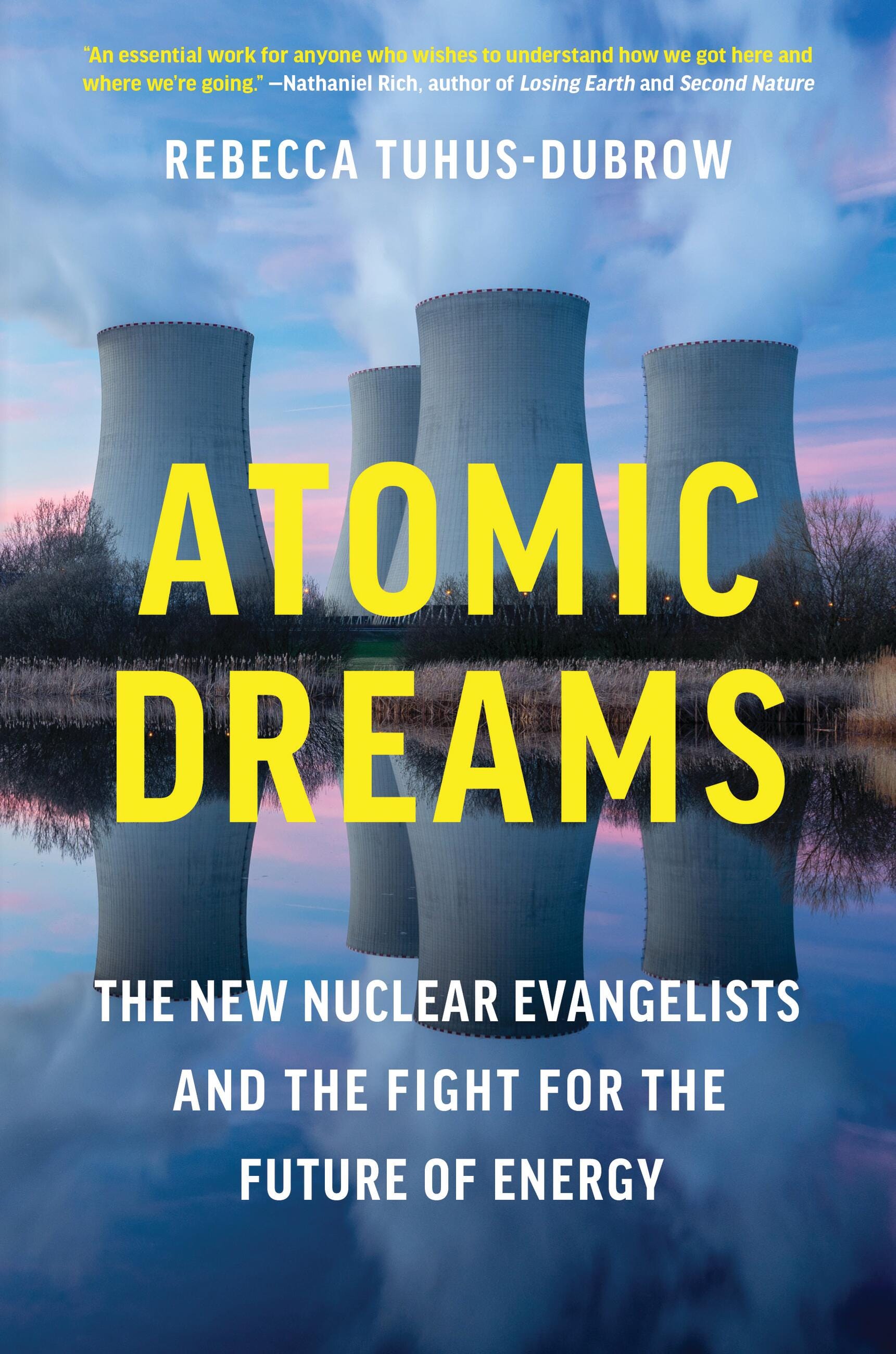
Journalist and lifelong environmentalist Rebecca Tuhus-Dubrow tackles those questions in her recently released book, Atomic Dreams: The New Nuclear Evangelists and the Fight for the Future of Energy. To her own surprise, the many months of research she put into it left her not exactly won over, but more open than she expected to the arguments of the pro-nuclear camp.
It’s not a critical metals story per se, but it is an issue that has a powerful bearing on the energy transition, so I was very pleased to have the opportunity to chat with Rebecca about it all. Herewith, the highlights of our conversation (condensed and edited somewhat for flow).
Vince: What’s the argument in favor of nuclear, in the context of the energy transition?
Rebecca: There are a few major arguments in favor of nuclear. One is that it’s low carbon, of course. I use that term because “carbon free” is not really accurate to describe any energy source. There are greenhouse gas emissions at different stages of the process from extraction to waste disposal for any energy source, including renewables. But according to reputable studies I’ve seen, nuclear is roughly equivalent to say wind and solar.
Also, nuclear can run 24/7. When the sun isn’t shining or the wind isn’t blowing, solar and wind are not producing electricity. Of course, batteries can provide backup, but that’s still fairly limited. So reliability is the second argument for nuclear.
Another one is just the sheer energy density of nuclear. You can provide much more electricity per land unit and also per material inputs with nuclear than you can with wind and solar.
Vince: In other words it takes way less space to produce the same amount of energy?
Rebecca: Right.
Vince: OK. Let’s talk about the downsides. It seems like there are two really big issues. The first one is waste. In your book you explain that pro-nuclear folks say, “It’s really not a problem. Yeah, there’s this radioactive waste, but it’s treated with enormous caution, packed away in casks and encased in concrete. And anyway, there have never been any problems and so we really don’t have to worry about nuclear waste.” I get that it hasn’t been a problem yet. There hasn’t been an earthquake or a terrorist incident or some kind of catastrophe that’s scattered radioactive waste all over the place. But it seems like a really big potential problem, no?
Rebecca: Well, the waste, the spent fuel, is a dangerous substance. When it comes out of the reactor, just being in the same room with it would kill you. Within minutes you would receive a fatal dose of radiation. So I don’t think anyone should make light of that. But pro-nuclear advocates are correct that because it’s so dangerous, we take extreme measures. We handle it in a way that really isolates it from causing any harm by storing it first in cooling pools and then in these steel canisters surrounded by concrete.
If you compare that to the waste from fossil fuels, which has just spewed into the atmosphere for hundreds of years with very few controls and caused millions of deaths via air pollution in addition to the massive harms of climate change … I think putting it in that context really does change the way I think about it.
Vince: So in other words, it’s bad, but it’s less bad than the toxic waste created by fossil fuels.
Rebecca: Yeah, it’s much less bad, I think, in terms of the harm actually caused. In terms of potential harm, I think certainly without rigorous regulations or if we had some kind of really apocalyptic societal collapse, and we were not able to monitor the waste anymore in the way that we have been, then yes, certainly there could be major problems.
Vince: The thing that I was raised worrying about is a catastrophic accident. You know, the China syndrome, the big meltdown, Chernobyl, Fukushima. The terrifying fear that if something goes wrong, it can go catastrophically wrong. So, what about that?
Rebecca: Well, the worst nuclear accident by far at a civilian nuclear power plant in history was Chernobyl. But one thing to note about that is that the reactor design was flawed. For instance, it didn’t even have a containment dome. In the US all of our nuclear reactors are surrounded by these concrete domes intended to prevent any radioactive releases from getting out. So an accident like Chernobyl couldn’t happen here, or, I don’t think, at any currently operating reactor in the world.
Of course, Fukushima was a lot more recent and is certainly disturbing, especially since it was caused by a tsunami. And in today’s world we have these various so-called natural disasters of increasing frequency and intensity. So they could pose increasing risks at nuclear plants. But it would not be anything like the scale of Chernobyl. And the new reactors that are in development, many if not all of them have what are called passive safety features. That basically means that the physical characteristics of the reactor itself would prevent a meltdown from happening, as opposed to having, like, an engineered way to turn it off. At least in theory they make a meltdown impossible. But it’s certainly possible that accidents can happen.
And I would add that since Trump took office he’s been really trying to undermine nuclear regulation in the US, which is disturbing. I think it’s really important to have robust regulation. These moves may increase the chance that we could have an accident.
Vince: So, where does “catastrophic accident” stand on your list of things to worry about?
Rebecca: It’s not that high.
Vince: Yeah?
Rebecca: Yeah. I think there are a lot of safeguards in place and nobody wants to have a catastrophic accident. Except for maybe terrorists. I think part of the reason I was more open to nuclear power in the first place is that climate change was at the top of my list. And I learned that nuclear could play a role in mitigating climate change.
Vince: Nuclear is kind of having a comeback in the US and around the world these days. Give me a sense of the trajectory.
Rebecca: So, China and Russia have been the countries that built the most new nuclear in the past decade or even few decades. We’re talking not hundreds or thousands of plants, but like in the dozens. In the US, there’s been a great deal of interest, I’d say, for the past decade or so. There’s been a series of bipartisan laws intended to nurture the advanced nuclear industry.
The challenge is that as opposed to solar and wind, which you can now just put up really quickly and really cheaply, nuclear plants are often over budget and go past deadline. That’s something nuclear proponents and the sector really need to address if they’re going to succeed.
Vince: So, what about the small modular reactors we keep hearing about? Is that even a real thing or is that just a concept at this point?
Rebecca: It’s a concept that is I think coming close to becoming reality. China and Russia are at the forefront of SMR development, but none have been deployed yet.
Vince: Let me switch gears here a little bit. I write about metals and raw materials. Uranium is the primary raw material we’re talking about, yeah? Where are we getting our uranium from these days?
Rebecca: Russia actually provides a quarter of the enriched uranium that the US imports. Which has been a problem. In the aftermath of Putin’s invasion of Ukraine in 2022, there were all of these sanctions placed on other energy sources, but we actually didn’t touch the uranium.
Vince: No kidding. That’s so interesting because we did the same thing with Russian nickel. So Russia is also an important enough supplier of enriched uranium that we depend on them to some extent?
Rebecca: Yeah, to some extent.
Vince: That doesn’t seem like a very good strategic position to be in.
Rebecca: There was also this amazing non-proliferation program in the wake of the Cold War. The US started paying Russia to dismantle excess nuclear weapons and they would downblend the highly enriched uranium in the weapons into low-enriched uranium and then ship it to the US. And we used it in our nuclear reactors as fuel.
Vince: Wow.
Rebecca: For a 20-year period from 1993 to 2013, that low-enriched uranium supplied 10% of our total electricity. Which is a pretty staggering figure.
Vince: No way. Let me make sure I understood that. We were getting 10% of our electricity from uranium that had been basically salvaged from Russian nuclear missiles?
Rebecca: Yes! The revenue helped stabilize Russia’s economy and integrate it into the global economy. It had all of these incredible benefits, but one unintended consequence was that we did start to depend on Russia for low-enriched uranium and our own capacity to enrich uranium kind of atrophied.
Vince: So what’s your bottom line? Nuclear good or nuclear bad?
Rebecca: I ended up thinking that there’s no perfect energy source. What probably makes the most sense is to have a portfolio of these different low-carbon sources that have different advantages and different disadvantages. Probably my preference would be to have nuclear providing what’s known as base load or dispatchable energy to the extent that it can help stabilize the system but also have lots of wind and solar and batteries that can do most of the work most of the time.
My own views kind of evolved over time. I think because I was writing about people, some of whom had an almost religious passion either for or against nuclear, that made me want to be sure that I remained open-minded and open to new evidence as it emerged, open to changes in the energy system, because it’s changing so quickly.
It's always refreshing to see someone willing to change their mind when learning more about the subject. One correction: there are actually a couple of small modular reactors in operation- one in Russia and one in China.
Details here: https://alchristie.substack.com/p/microreactors-small-modular-reactors
"Much less bad" and dismissing catastrophic events - she hasn't changed my mind.
No to nuclear power. Period. We have much better options.